
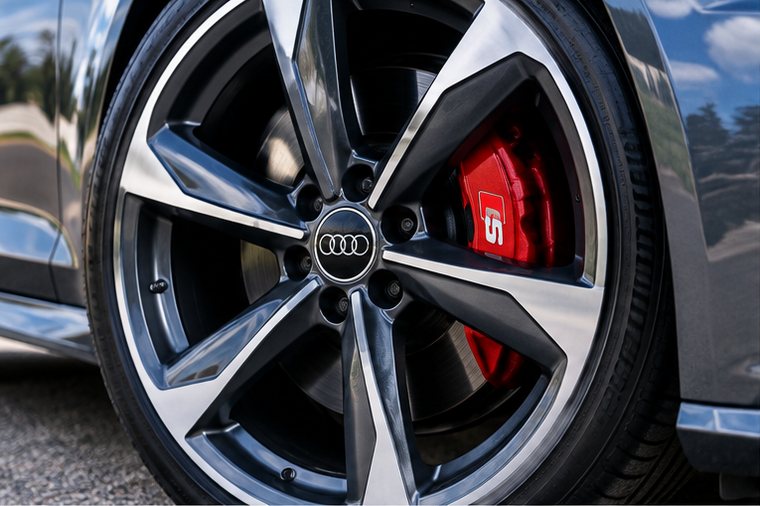
How Much Does Alloy Wheel Refurbishment Cost in Somerset?
What actually decides the price of an alloy wheel refurbishment, why nobody can quote properly from a description alone, and how to get an accurate figure.
Read the guide
Nearly always because something went on top of a surface that was not right underneath. Once you know that, the peeling wheel makes a lot more sense.
This is the whole answer in one line. Paint, lacquer and powder coating all rely on adhesion, and adhesion is decided by preparation. Put a good finish on a poorly prepared wheel and it will look excellent for a season and then start letting go.
It usually starts at an edge - the rim lip, a spoke edge, the perimeter of an old repair - because that is where the coating is thinnest and most exposed.
A wheel that was smart-repaired quickly and cheaply, where the damage was filled and covered rather than taken back properly, is the single most common flaking wheel we see. The repair looks fine when it is handed over and lifts around its own edges within a year or two.
That is not an argument that all quick repairs are bad. It is an argument that the preparation is what you are actually buying, and it is the part you cannot see in the finished result.
Where moisture has got to the metal through a chip or a kerb mark, oxidation spreads under the lacquer and pushes it off from below. The clear coat lifts in a patch with a ragged edge, often with white powdery residue when you look closely.
Coating over that is what previous repairs did. It has to come out.
Wheels get hot from the brakes, cold from the weather, salted all winter and hit with cleaning products regularly. That is a hard life for any coating, and a poorly bonded one gives up under it long before a properly applied one does.
Strong acidic wheel cleaners are worth a mention. They shift brake dust effectively and they are not kind to a wheel finish, particularly a diamond-cut or a machined one. A pH-neutral cleaner and a brush does the job without the collateral damage.
Any break in the finish is a way in for moisture. A kerb scuff left alone for two winters is not just a scuff any more - it is a corrosion site with a lifting edge around it.
Which is the practical case for dealing with damage when it happens rather than when it annoys you enough.
Taking the old finish and any corrosion off properly, preparing the surface, and applying the new finish to a sound wheel. There is no shortcut and no product that substitutes for it.
That is what we mean by a full process rather than a smart-fix, and it is why the work carries a one-year guarantee. If a wheel we have refurbished starts lifting, tell us.
Edges are where a coating is thinnest and where poor preparation shows first. Usually it means the surface underneath was not right.
No. It would lift again from the same place. The old finish has to come off.
They are hard on wheel finishes, machined ones especially. A pH-neutral cleaner and a brush is kinder and works.
Send us the details, or a photograph, and we will come back to you. If it is urgent, call 07967 954416 rather than waiting for a reply.
What actually decides the price of an alloy wheel refurbishment, why nobody can quote properly from a description alone, and how to get an accurate figure.
Read the guide
What drives the cost of alloy wheel powder coating, how it differs from a standard refurbishment on price, and what to ask before you book.
Read the guide
When kerbed alloy wheels can be refurbished and when they cannot, how to tell the difference yourself, and what to do about the ones that cannot.
Read the guide
How powder coating differs from a standard alloy wheel refurbishment, which suits which problem, and how to choose between them.
Read the guide
How long alloy wheel refurbishment takes, what makes it longer, and what same-day service actually means in practice.
Read the guide
Whether corroded alloy wheels can be saved, how to tell how far it has gone, and why corrosion comes back when it is only covered over.
Read the guide
Changing alloy wheel colour during a refurbishment: what is involved, what to think about before choosing, and the practical points people forget.
Read the guide
How mobile alloy wheel refurbishment works in practice, what to have ready, and which jobs suit a visit and which do not.
Read the guide
When an alloy wheel is beyond refurbishment and should be replaced, how to tell, and why making a damaged wheel look good is the wrong answer.
Read the guideFree consultation, a one-year guarantee, and a mobile service covering Somerset and Avon. Open 9am till 6pm, Monday to Sunday.